
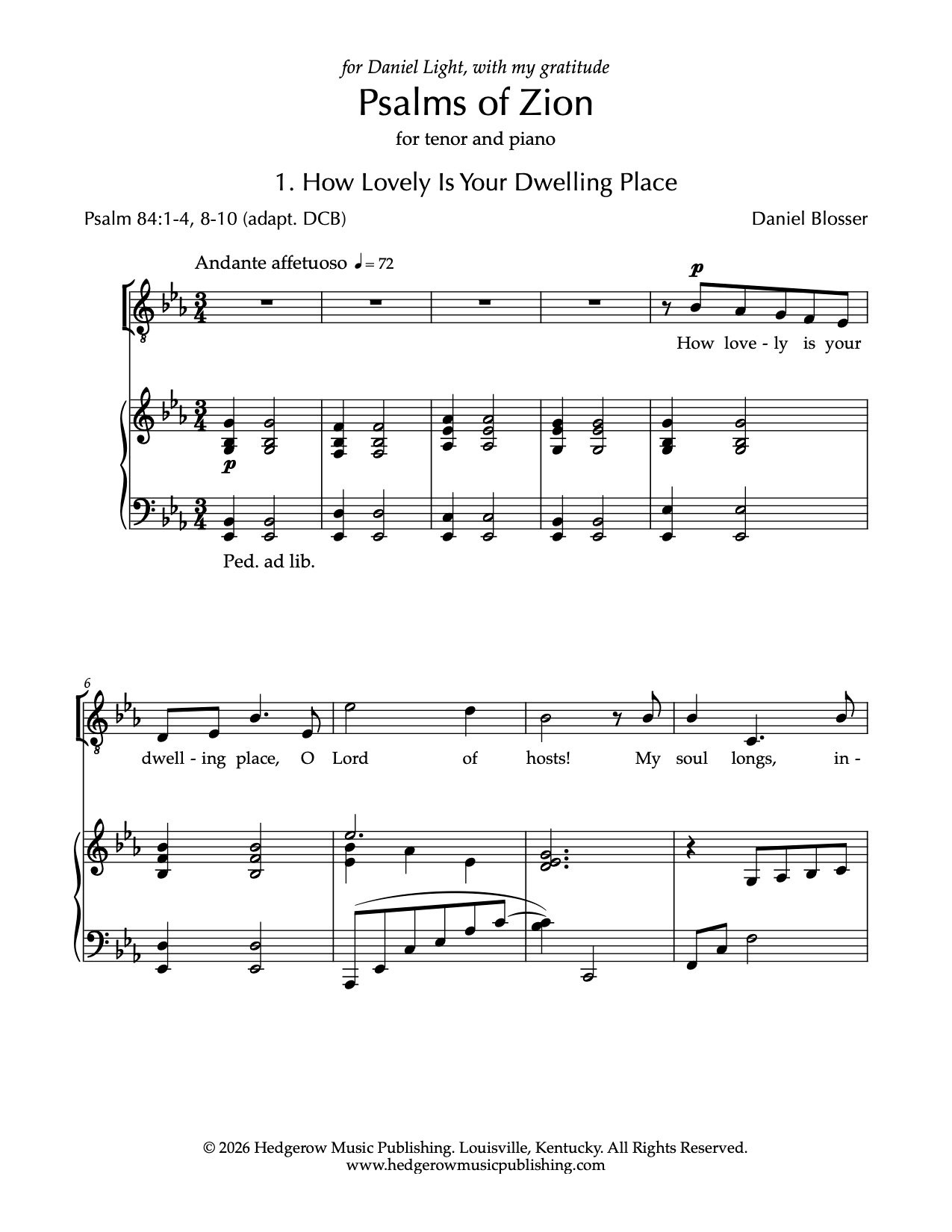
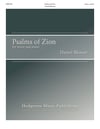
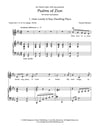
It was the fall of 2024 when I started work on a solo setting of Psalm 84, “How Lovely Is Your Dwelling Place.” I had a little melody that I liked, and it proved to be malleable enough to use throughout the setting in various keys and textures. It even worked in different meters. I completed my setting, but something felt unfinished. I sat down at my piano and let my mind wander. I played that original melody in as many different ways as I could imagine- fast, augmented, whole-tone scales, retrograde, mixed meter, etc. Somewhere in that brainstorming session emerged the material that would become the end of ”Great is the Lord,” and that is where the concept of Psalms of Zion truly began.
Since Psalm 84 is credited to the priests of Korah, I started my research there. Perhaps a set of songs unified by this attribution would be a fun thing to work on. And unquestionably all of those psalms are meaningful. However, they did not all inspire music within me. So instead, I turned to a looser kind of connection: psalms that reference Zion, Jerusalem, or the Kingdom of God. This gave me an interesting palette with which to work, and theologically, a topic that spoke to me. Since some of these psalms were written before the exile and some after, they vary greatly in character. I resonated deeply with those moments where the psalmists felt Jerusalem was close and others when it felt far away. So, I picked my psalms and ordered them to resemble a spiritual pilgrimage — one that ends with the narrator becoming one with their Creator, swept up into a transfiguration that leaves meter and tonality behind.
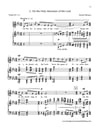
I’ve been asked more than once why I included an interlude after the second movement. There are three reasons. The first is emotional balance. Once I had determined the length and formal structure of the work, I felt that “By the Waters of Babylon” was going to be too jarring following the second movement. I had seen Roger Quilter do something similar in his cycle To Julia, and Robert Schumann used lengthy postludes to help control the pacing of his vocal music, so I felt emboldened to try a similar tactic. Emotionally, the interlude is intended to bring the listener down into the nadir where “By the Waters” lives and place it more squarely at the half-way point of the cycle.
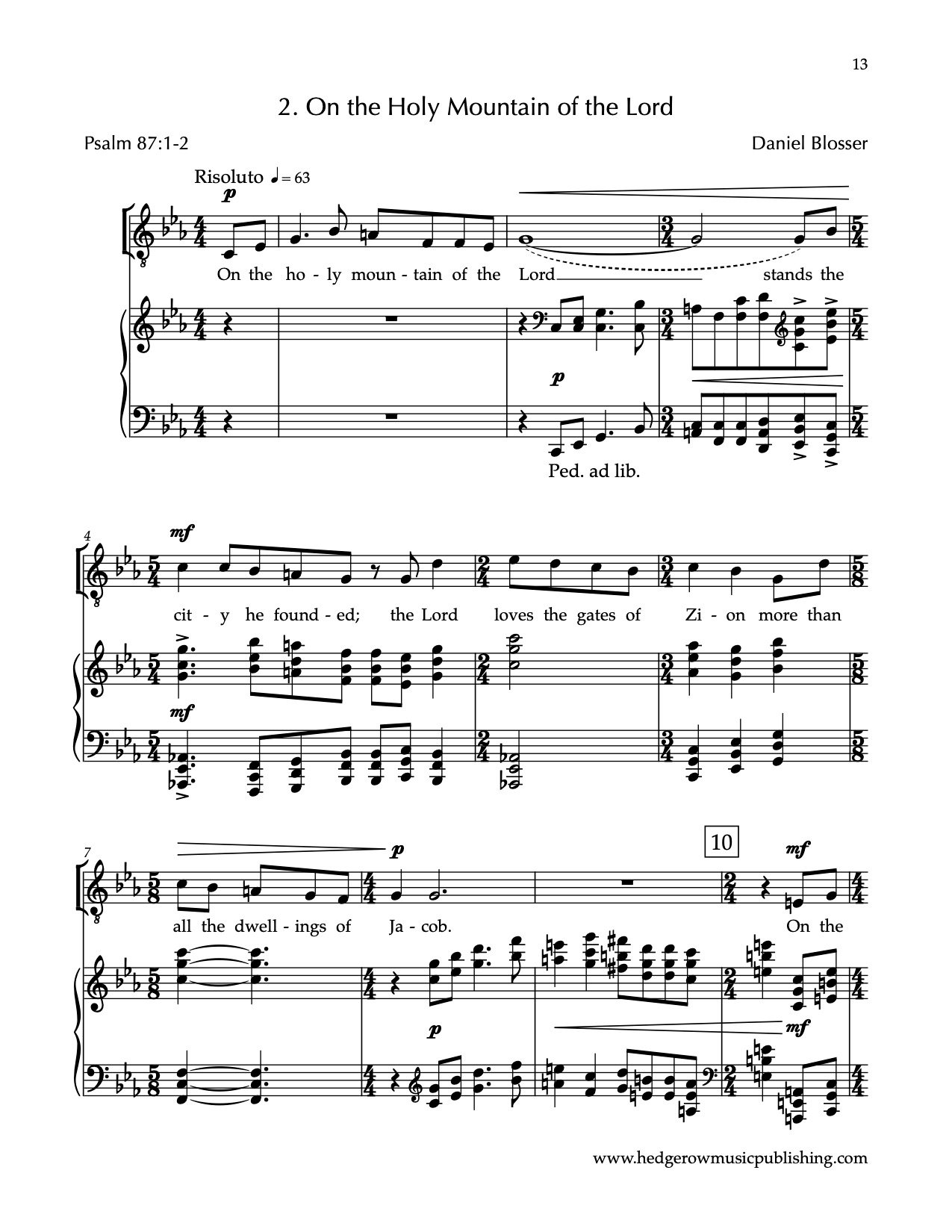
The second reason I decided on an interlude was to further elevate the role of the piano in the storytelling. As I wrote each movement, I was intentional about liberating the piano from standard patterns. I wanted a plethora of textures, countermelodies, and polyphony against the vocal line. I didn’t want the performer to assume that the piano was subservient to the vocal line all the time. The interlude furthers this aim.
The third reason was not intentional but emerged as I was writing the interlude. I quite literally said to myself, “I want this to sound like something Daniel Light would write.” Daniel, my friend and colleague, is a spectacular composer whose piano music is lush and adventurous but never alienating. I have had the pleasure of hearing him play piano every Sunday for ten years, and all of us at Christ Church have grown so accustomed to his style that we can identify his playing with our eyes closed. The interlude ended up being little more than homage to his music — certainly not matching his charming idiosyncrasies — but it made me think deeply of him, his impact on my life, and his unwavering support of my music. Since Psalms of Zion was my most ambitious project to date, and since I would have never had the confidence to complete such a task without Daniel’s encouragement, I dedicated the work to him.
In total, it took about eighteen months for me to finish Psalms of Zion. A more disciplined composer would have finished much quicker. I gave in to some indulgences and rookie mistakes that resulted in me writing myself into a corner, putting the piece away for a few weeks, and then painfully editing my work like a driver making a three-point turn. Letting one’s imagination run wild is quite fun but not very productive. It is no surprise, therefore, that the movement I am most proud of is the one that had the thickest guardrails. I charted the passacaglia in “By the Waters” in a spreadsheet before I ever put a note on paper, and that made the creativity more focused and the rewrites almost nonexistent.
The work was premiered by Daniel and me on September 20, 2026, at a concert celebrating my ten years of ministry at Christ Church. I am quite proud of the finished product — it is unabashedly “me,” reflecting my musical taste and theological proclivities. Writing the piece brought me great satisfaction, dedicating it to Daniel brought me deep gratitude, and performing it brought me immeasurable joy. I hope the work has an afterlife beyond that night, but if it does not, I am at peace. I consider myself enormously fortunate to have created something personal and shared it with a room full of friends. There are few things in life more fulfilling than that.
Thanks for checking it out and for continuing to support my music,
Dan
P.S. If you have never encountered Daniel Light's music, you will want to. It can be found here.
Comments ()